Quick Draw
You draw. The brain guesses while you draw.
Six things, twenty seconds each. Doodle on the pad and a neural network running in your browser calls out what it sees, stroke by stroke, until it gets it or the clock runs out. It learned 132 things from millions of other people's doodles, it lives in the page, and nothing you draw leaves your browser.
- Web
- Free
- Private
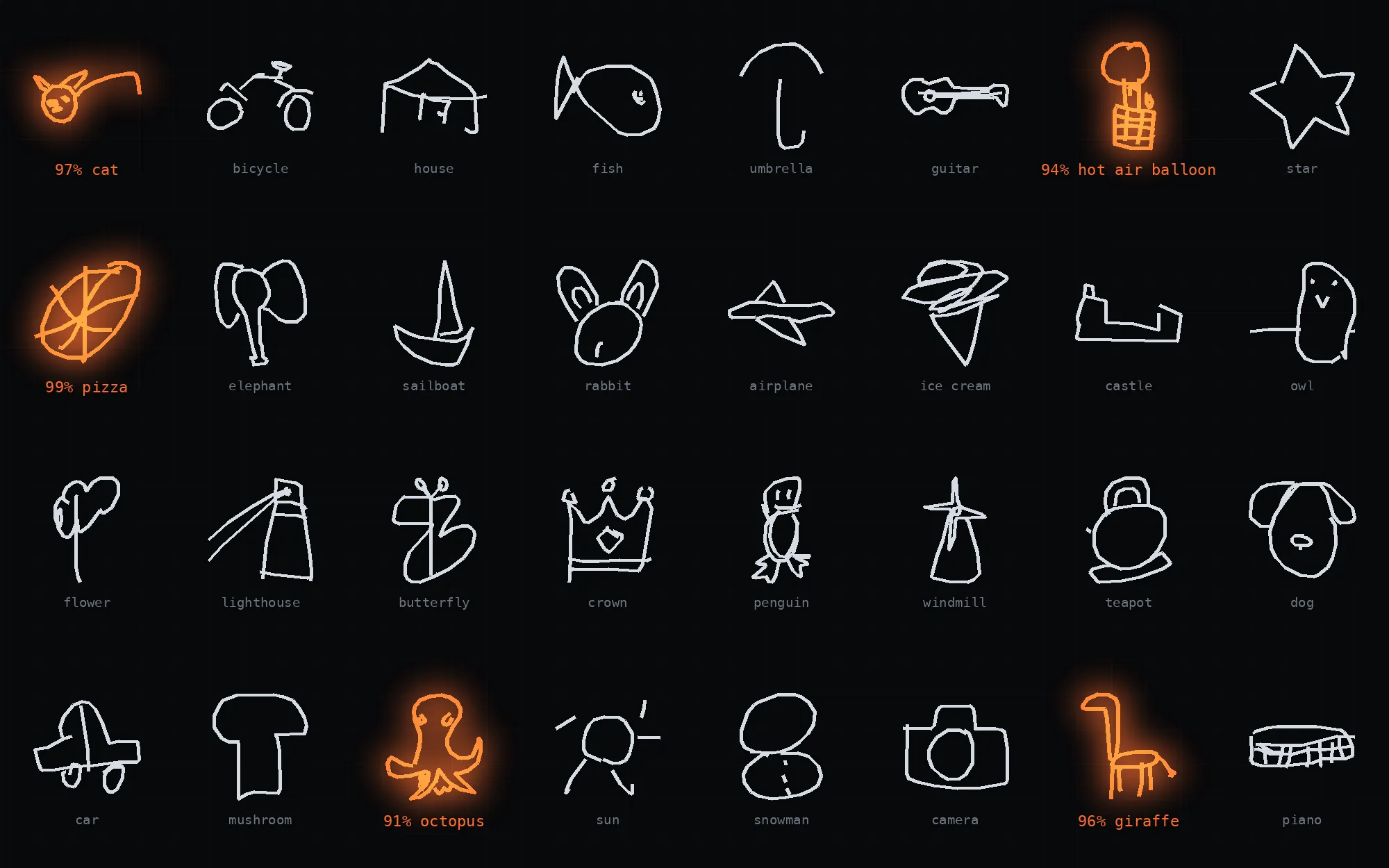
- 132 things it can recognize
- 20 seconds per drawing
- 6 rounds per game
- 0 bytes sent to a server
A pad, a clock and a brain that thinks out loud.
The pad takes a mouse, a trackpad, a finger or a pen. Beside it, the brain's five best guesses with their confidence, the 28 by 28 picture it actually looks at, and the time each guess took. Under it, Undo, Clear and Skip.
Six rounds
Each round names a thing and starts a twenty-second clock. Draw it; the moment the brain's first guess is that thing, the round is won and the time is kept. Run out of clock and the brain tells you what it thought you were drawing.
Guesses while you draw
The brain looks at the pad several times a second, even in the middle of a stroke, and says what it sees: a hunch between two things, a guess, a certainty. The five best guesses sit beside the pad with their confidence as bars.
Free draw
No clock, no target: draw anything and watch the guesses move as the picture takes shape. Undo a stroke, clear the pad, or save the drawing as a PNG with the brain's verdict written under it.
What the network sees
Your strokes are shrunk to a 28 by 28 picture, the same size the brain learned from, and that picture is shown beside the pad as it changes, with the milliseconds each guess took.
How other people drew it
At the end of a game, each thing you were asked to draw comes with six real doodles of it from the dataset the brain learned from, next to yours.
Nothing uploaded
The network is about one megabyte, downloaded with the page and run in a worker thread of your browser. Strokes, guesses and scores never leave the tab; there is no server behind the game.
The drawings stay on the pad.
The brain is a small convolutional network sent to the browser as a file and run there, in a Web Worker. Every stroke is turned into a picture and judged on your machine; nothing is sent, stored or scored anywhere else. Saving a drawing writes a PNG to your computer and nowhere else.
- The network runs in your browser, in a worker thread
- No account, no upload, no server behind the game
- A saved drawing is a PNG on your computer; the page keeps nothing
Requirements
- Runs in
- A recent browser, on a computer, a tablet or a phone
- Downloads
- About one megabyte for the brain, with the page; 130 KB more for the gallery at the end of a game
- Uses
- The mouse, the trackpad, a finger or a pen; nothing else
- Account
- Not needed
- Price
- Free
Questions
Does it really run in my browser?
Yes. The brain is a convolutional network of about seven hundred thousand weights, loaded with the page and run in a Web Worker, in plain JavaScript. A guess takes a few milliseconds on a laptop and a little longer on a phone. Nothing is sent to a server.
What did it learn from?
From the Quick, Draw! dataset, published by Google under the Creative Commons Attribution 4.0 license: fifty million doodles drawn by players of the game of the same name. This brain learned 132 of its 345 things, from ten thousand drawings of each, and it also saw them half finished, so it can guess before you are done.
What does it know?
Animals (cat, dog, elephant, octopus, penguin, zebra), things around the house (chair, clock, cup, key, scissors, toothbrush), vehicles (bicycle, bus, helicopter, sailboat, train), food (apple, banana, donut, ice cream, pizza, watermelon), places and weather (castle, lighthouse, mountain, rainbow, tornado, The Eiffel Tower), and more: the Play screen says how many, and each round names one.
It did not get my drawing. Why?
It only knows how the players of Quick, Draw! drew that thing, usually in a few quick strokes and from the most common angle: a side view of a cat, a house with a roof and a door. Shading, detail and unusual views confuse it; a simple outline is what it expects. The gallery at the end of a game shows how other people drew each thing.
Can I draw whatever I want?
Yes: Free draw has no clock and no target. The guesses update as you draw, and Save PNG keeps the drawing with the brain's verdict written under it.
Is my score kept anywhere?
No. The score is on the screen at the end of a game and goes away with the page. There is no leaderboard and no account.