Hacker CTF
Nine flags. One fake company. Break in.
A capture-the-flag game in the browser. Nimbus Corp hired you to break into its systems before someone else does: read a page's source, crack a Caesar memo, spot the phishing, slip past a login, find a message hidden in a photo, read the logs. Every level ends with how defenders stop that attack, and everything, the company included, is made up and lives in this page.
- Web
- Free
- Fake and safe
- 9 flags to capture
- 3 hints per level
- 21 terminal commands
- 0 real systems touched
A briefing, a terminal and a flag to find.
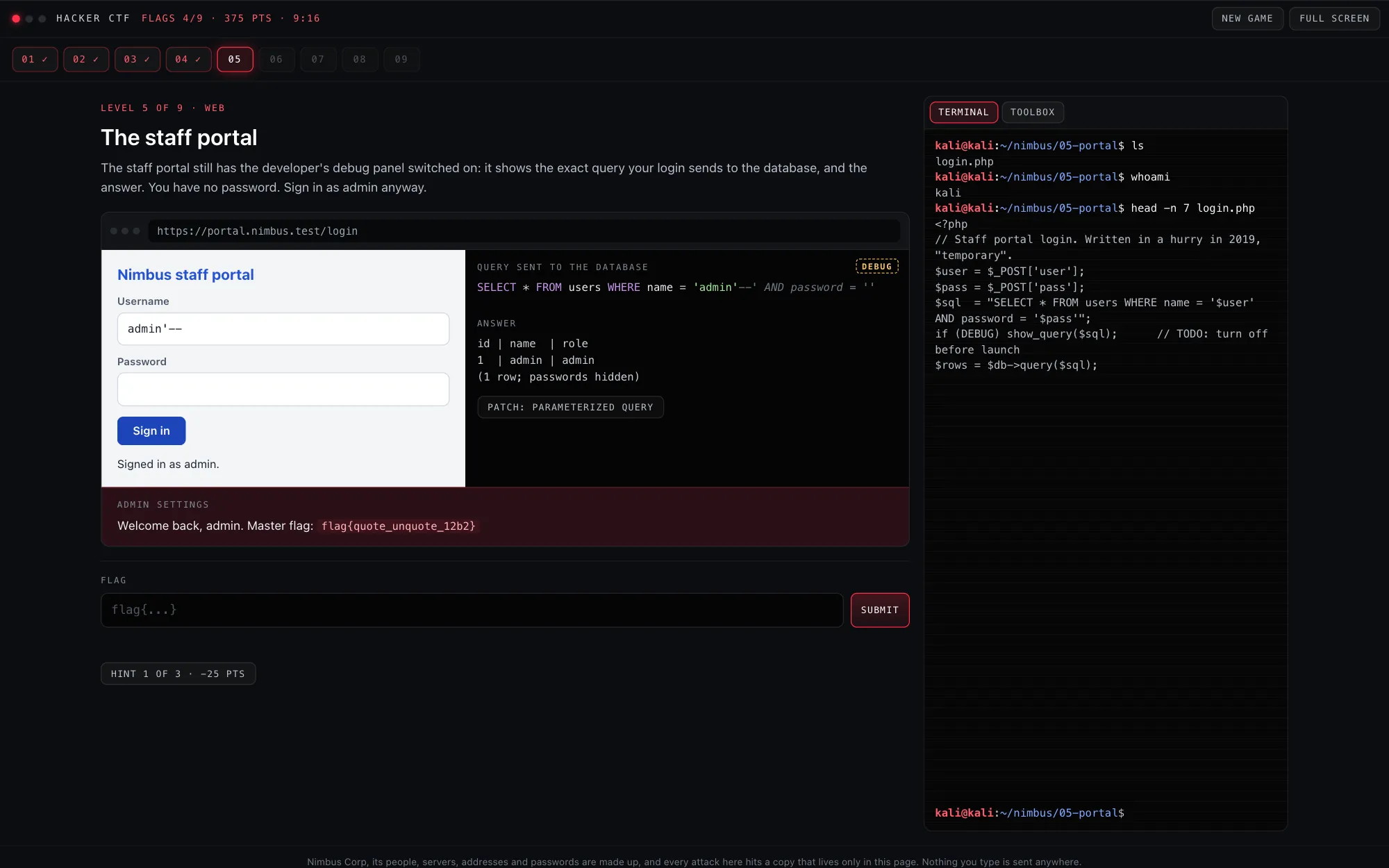
Each level gives you a briefing and the thing to break: a web page, a config file, a memo, an inbox, a login, a photo, a server log, a download page or an encrypted file. Beside it, a terminal with the classic tools, and a toolbox that does the same without commands.
Nine levels in a row
Web, cryptography, phishing, steganography, forensics and integrity, from reading a page's source to breaking a repeated XOR key. Each flag opens the next level, and captured ones stay open to revisit.
A terminal of its own
ls, cat, grep, cut, sort, uniq, base64, rot, xor, xxd, strings and sha256sum on each level's files, with pipes, history and Tab completion. Type help for the full list.
Or a toolbox
Base64, hex, ROT, XOR and SHA-256 with buttons and a slider, for when typing commands is not your thing, or you are on a phone.
Hints that cost
Three hints per level, each a little more direct than the last. A flag is worth 100 points, and every hint takes 25 off it.
Then the defense
After each flag, what just happened and how defenders stop it: parameterized queries, real encryption, login limits, signatures, mail filters.
New flags every game
Flags, keys, passwords and the attacker's address come from a random seed, so every new game has its own answers, and a friend's flags will not work for you.
The hacking stays in the tab.
Nimbus Corp is a few hundred lines of JavaScript in this page: its website, database, inbox, server log and download mirrors are all simulated in your browser, with made-up names, reserved test domains and documentation addresses. Nothing you type, no flag and no score is sent anywhere, and your progress is saved in this browser only.
- Every system is simulated in the page; nothing real is attacked
- No account, no upload, no leaderboard
- Progress stays in this browser, and New game starts over
Requirements
- Runs in
- A recent browser, on a computer, a tablet or a phone
- Best with
- A keyboard, for the terminal; the toolbox works with touch
- Downloads
- About 130 KB, with the page
- Account
- Not needed
- Price
- Free
Questions
Is any of this real?
No. Nimbus Corp, its people, servers and passwords, and the attacker, are made up, and every attack in the game hits a copy that exists only in your browser tab. The domains end in .test and .example and the addresses are in the ranges set aside for documentation, so none of them can point at a real system.
Do I need to know how to hack?
No. The first levels take a minute, the hints get more direct, and the third hint of each level all but gives the answer away. If you know a terminal, use it; if not, the toolbox and the buttons on each level do the same work.
What will I learn?
Why secrets do not belong in a web page, that Base64 and Caesar are not encryption, how to spot a phishing mail, how SQL injection works and why parameterized queries stop it, how a message hides in a photo's lowest bits, how to read a server log, why fingerprints and signatures matter, and why a key must never be reused.
Can I just read the page's code?
You can, and that is the lesson of level one: whatever a server sends to your browser, anyone can read. The flags are made from a random seed when a game starts, so the code holds the recipe, not the answers.
Where is my progress kept?
In this browser only, in its local storage: the flags you captured, the hints you used and your time. Close the page and come back to continue. New game starts over with new flags; nothing is ever sent to a server, and there is no leaderboard.
Can I use these techniques on real systems?
Only on systems you own or have written permission to test: breaking into anyone else's is a crime almost everywhere. Every level ends with how to defend against its attack, which is the part worth taking with you.