Quantum Chess
Chess, where a piece can be in two places at once.
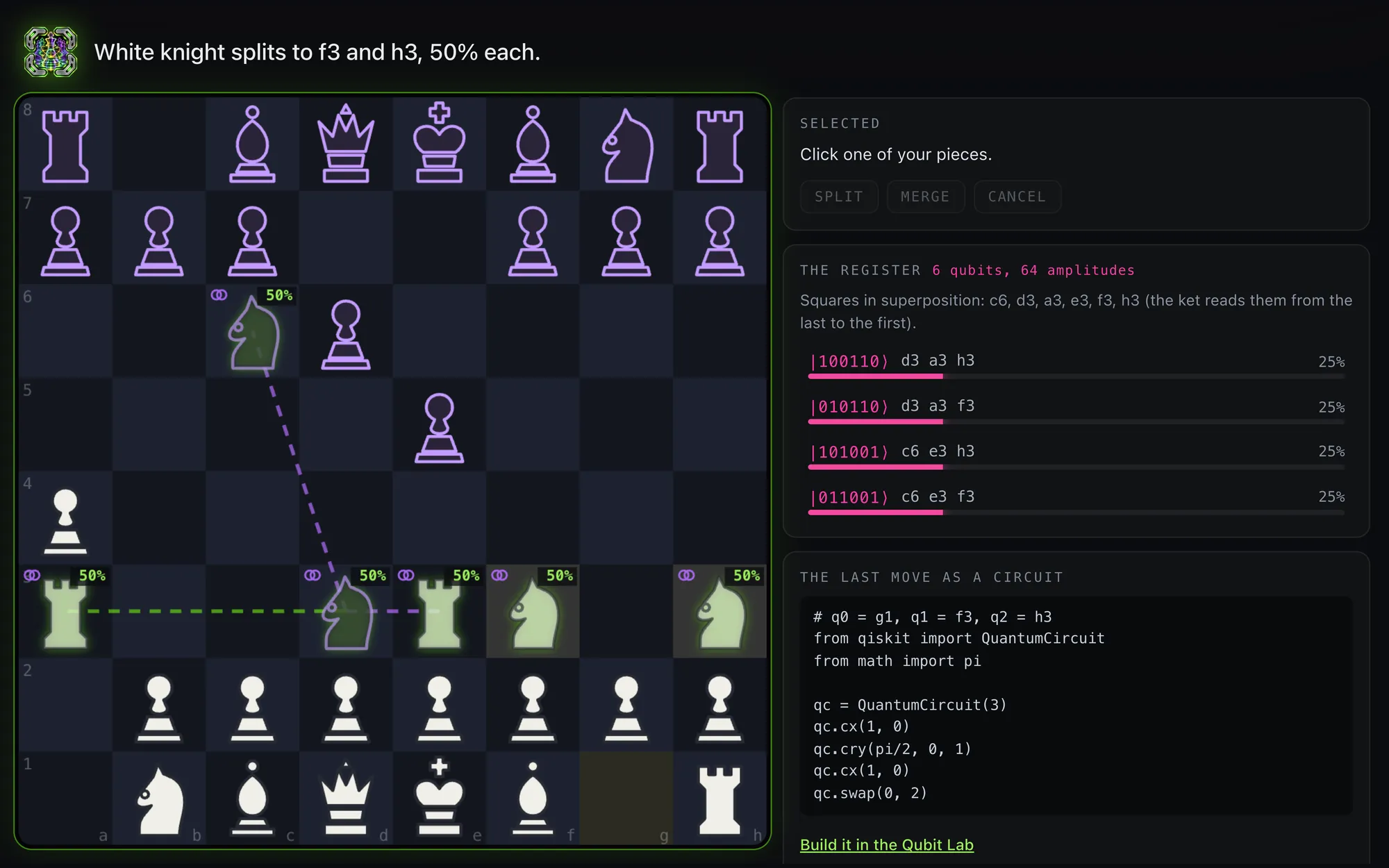
Split a knight onto two squares and it is on both, half and half, until something looks. Slide a rook through a square that may be occupied and the two pieces are entangled. Capture, and the board is measured: maybe the piece was there, maybe it never was. Every square in doubt is a qubit, simulated in your browser by the Qubit Lab's engine, with the register shown beside the board, amplitude by amplitude.
- Web
- Free
- Private
- 64 squares, each one a qubit when in doubt
- 50 percent on each square after a split
- 16 squares in superposition at once, at most
- 0 bytes sent to a server
A chessboard that is also a quantum register.
The board keeps the pieces; the register keeps the doubt. Every square that may or may not hold its piece is a qubit in a state vector, the same simulator the Qubit Lab runs, and every move is a circuit on it: a rotation for a split, a controlled swap for a slide through a maybe-piece, a measurement for a capture. Beside the board you read the amplitudes, preview each world, and see the Qiskit of the move you just made.
Split
Select a piece, press S and pick two squares it could move to. It is now on both, 50% each, drawn as a ghost with its odds. Split a copy again and it is on three.
Merge
Bring two copies back to one square, onto one of them or onto a square both can reach. Undisturbed, the piece comes back whole: the amplitudes add up, which is what makes this quantum and not just dice.
Capture by measurement
Moving onto an enemy measures the squares involved: is the mover really there, is the path clear, is the enemy there. Each answer flashes on the board with its odds. A capture that finds nothing still spends the turn, and the collapse stays.
Entanglement
A rook, bishop or queen can slide through a square that is only maybe occupied: it passes in the worlds where the square is empty and stays in the others. From then on, measuring one piece tells you about the other; the board draws the link when you point at either.
The register
Every uncertain square is a qubit, up to sixteen at once. The panel lists the basis states with their probability and the phase as a color, as the Qubit Lab does; hover one and the board shows that world. The last move is written as the Qiskit circuit it was.
Computer or a friend
Play White against a computer that reads the same odds you do and never peeks at a measurement before it happens, or share the screen with a friend. Full screen when you want the board big.
The whole game stays on the board.
The simulator is the Qubit Lab's state-vector engine, loaded with the page and run in your browser. Moves, measurements and results exist only in the tab; nothing is sent, stored or scored anywhere else, and there is no account.
- The quantum state is simulated in your browser
- No account, no upload, no server behind the game
- Nothing is kept when the page closes
Requirements
- Runs in
- A recent browser, on a computer, a tablet or a phone
- Rules
- Chess without check or checkmate: capture the king to win; no en passant; pawns promote to queens; castling with both pieces certain
- Quantum moves
- Split (S), merge (M), captures by measurement, entanglement through a square in doubt; up to 16 squares in superposition
- Opponent
- The computer, or a second player on the same screen
- Controls
- Mouse or touch; S, M and Esc on the keyboard
- Account
- Not needed
- Price
- Free
Questions
Is this real quantum mechanics?
It is the real arithmetic of it: the uncertain squares form a state vector of up to 65,536 complex amplitudes, every split, merge and slide is a unitary gate on it, and every capture is a measurement drawn with the Born rule. The simulator is the Qubit Lab's, the same code that runs its circuits.
How do I split a piece?
Click the piece, press S (or the Split button), then click two empty squares it could move to. The piece is on both with 50% each. Any copy can move, split again or merge later.
How do I merge?
Click one copy and then another copy of the same piece: the first moves onto the second. Or press M, click the other copy and pick a square both could reach. If nothing disturbed the two halves, the piece is whole again.
What happens when I capture a piece that may not be there?
The board measures. First the mover: is it really on its square? Then the path, square by square. Then the target: was the enemy there? If the mover was elsewhere, nothing moves; if the target was empty, the mover just moves in. Whatever is measured stays measured, and the turn is spent either way.
What is entanglement in this game?
When a sliding piece passes through a square that is only maybe occupied, it ends up moved in the worlds where that square was empty and stays put in the others. Its position and the other piece's are now one fact: measure either and the other is decided too. Point at a piece in doubt and the board draws the squares it is tied to.
Why is there no check or checkmate?
A king can be on two squares at once, so there is no fixed square to threaten. The game ends when a king is captured: the capture measures the king's square, and against a king in superposition it only wins when the king turns out to be there.
Can I undo a move?
No. A measurement cannot be unmade, and the game follows the same rule for every move. Menu starts over.
Where do the rules come from?
From Chris Cantwell's Quantum Chess (2016), simplified: no en passant, promotion only to a queen, and the split and merge as rotations in the subspace of one piece on two squares. The circuit of each move is shown beside the board, so you can check what was applied.